The Death of the Boring Lobby: How Master-planned Third Places Are Rewriting Condo Design


The Death of the Boring Lobby: How Master-planned Third Places Are Rewriting Condo Design
For decades, the luxury condominium lobby operated under a predictable, risk-averse blueprint. It was a sterile, glass-walled vestibule. A monolithic concierge desk defined the liminal space, flanked by a pair of pristine but painfully uncomfortable mid-century modern armchairs, and a token fiddle-leaf fig. Today, the world’s most progressive developers are dismantling these isolated footprints to make way for master-planned third places that prioritize community culture over architectural exclusion. Designers built the old model for transit, and prioritized security over community. The space stood as a physical manifestation of isolation, drawing a hard, defensive line between the private resident above and the public city below.
That era is officially over.
Today’s design-conscious urbanites no longer want to live in gated vertical communities. At the same time, the world’s most progressive developers realize that dead ground-floor square footage is a liability. Progressive teams are dismantling the traditional, isolated condo lobby. In its place, we see the rise of the borderless public realm and the emergence of master-planned third places, social surroundings separate from home and the workplace.
Executing these radical, high-density civic ecosystems requires a rare architectural alchemy. The grandest urban masterplans demand two distinct phases to succeed. First, a bold, avant-garde visionary must completely rethink what a city block can be. Second, institutional powerhouses must deploy the deep capital, operational discipline, and long-term stability required to cross the finish line.
We are currently witnessing this exact dynamic play out across Canada’s two most volatile and sophisticated real estate markets: Toronto and Vancouver. Through massive masterplans like Mirvish Village, Oakridge Park, and The Well, the industry is proving a new thesis. When visionaries and finishers align, the ground plane becomes a canvas for culture, community, and unprecedented asset appreciation.
Mirvish Village (Toronto): Reimagining the Urban Living Room
Few urban sites carry as much emotional weight as the corner of Bloor and Bathurst in Toronto. Once home to the chaotic, neon-lit discount empire of Honest Ed’s, the site demanded a sensitive redevelopment. The neighborhood required a design that honored its vibrant, working-class marketplace legacy rather than erasing it.
Westbank masterfully conceived the project alongside Henriquez Partners Architects. They established a brilliant design ethos that said goodbye to monolithic tower pods. Instead, they prioritized micro-retail, fine-grained pedestrian pathways, and the meticulous preservation of 10 historic Victorian homes along Markham Street.
However, turning a visionary masterplan into an operational reality requires immense institutional stamina. Recognizing the scale of the asset, Peterson Group stepped in to take full ownership. They guided this massive, multi-tower rental and retail ecosystem to its completion. Peterson’s steady execution ensured that property management realities didn’t compromise the architectural poetry of the site.
The Ground Floor as a Social Catalyst
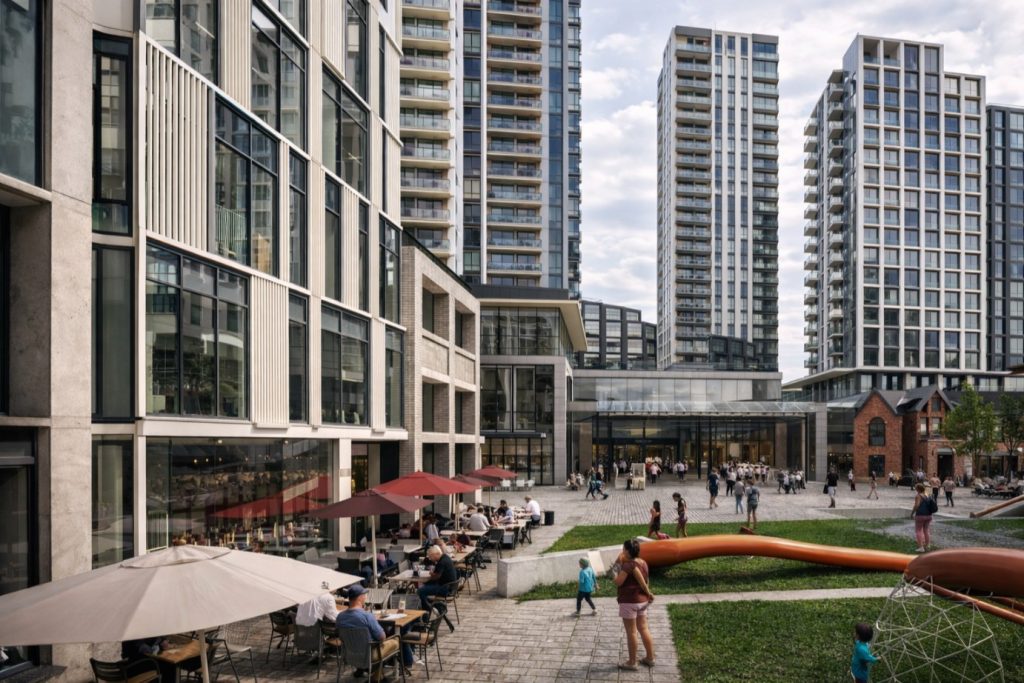
At Mirvish Village, the developers completely subverted the traditional condo lobby. Instead of entering an isolated tower through a private door, residents step directly into a 200,000-square-foot public realm. This space centers on Honest Ed’s Alley, a vibrant pedestrian thoroughfare lined with micro-retail stalls, local artisans, and public art that mirrors the energy of the historic marketplace.
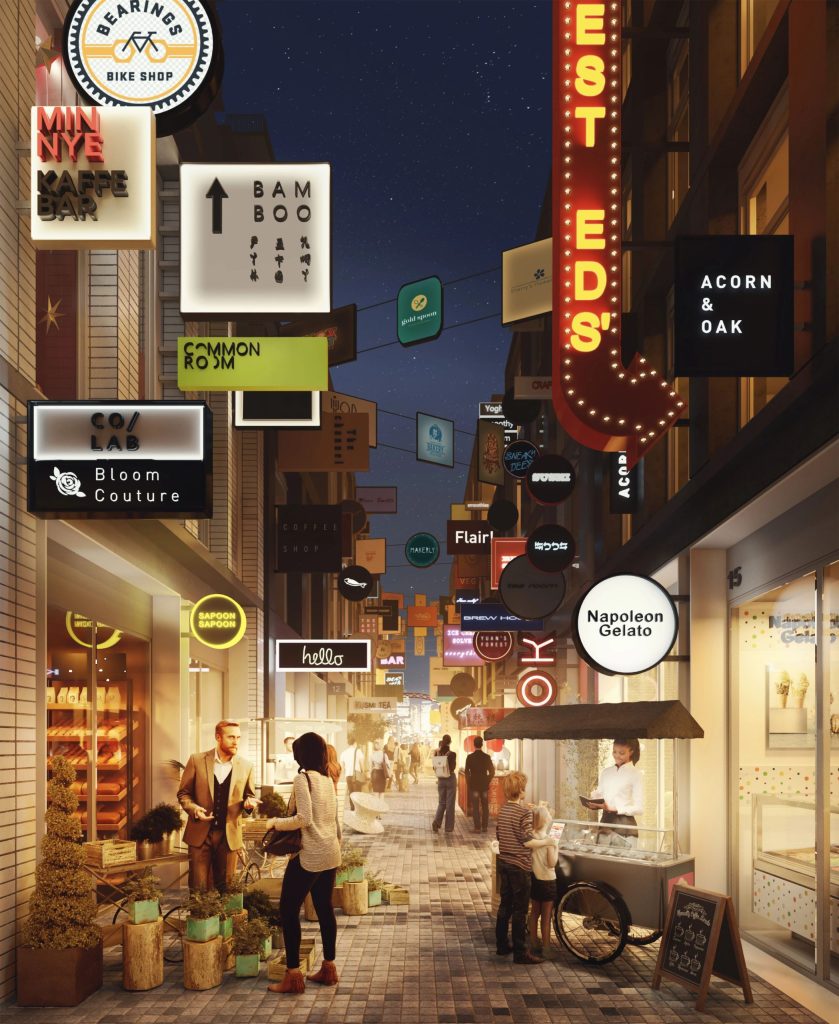
Massive glass facades pull back entirely during warmer months, dissolving the threshold between inside and outside. Residents and neighbors intermingle naturally throughout a hyper-curated culinary mix, completely bypassing the typical maze of security checkpoints. By prioritizing neighborhood staples, including a highly anticipated second location for Toronto’s cult-favorite Pizzeria Badiali, the development replaces the sterile security desk with an active, community-driven living room. This design fosters a lively, self-policing public ecosystem where people actually want to linger.
Oakridge Park (Vancouver): The Civic Ecosystem
If Mirvish Village is a study in master-planned heritage integration, Vancouver’s Oakridge Park represents a radical suburban transformation. Builders are re-engineering a mid-century, 1950s strip mall and its massive asphalt parking lot into a 5-million-square-foot, high-density cultural epicenter.
Westbank originally conceived Oakridge Park through a grand, ambitious lens, designing it as a futurist utopia. But a project of this astronomical scale requires institutional backing of the highest order to reshape Vancouver’s West Side. QuadReal Property Group, a global investment giant, has provided the robust financial execution and operational precision required to deliver this monumental masterplan. The project’s highly anticipated retail grand opening happened in late May.
The Ultimate “Lobby Alternative”
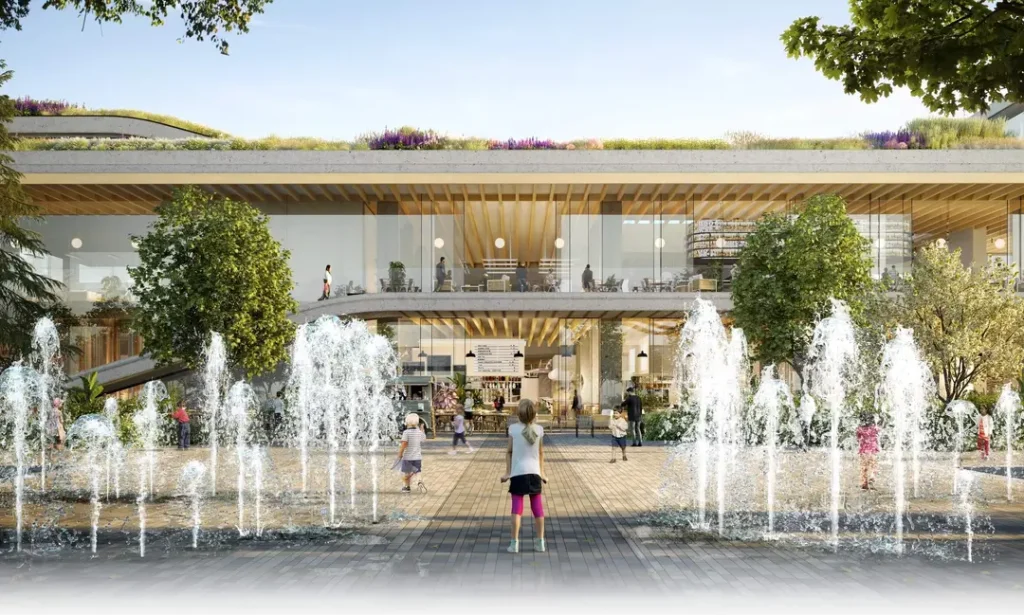
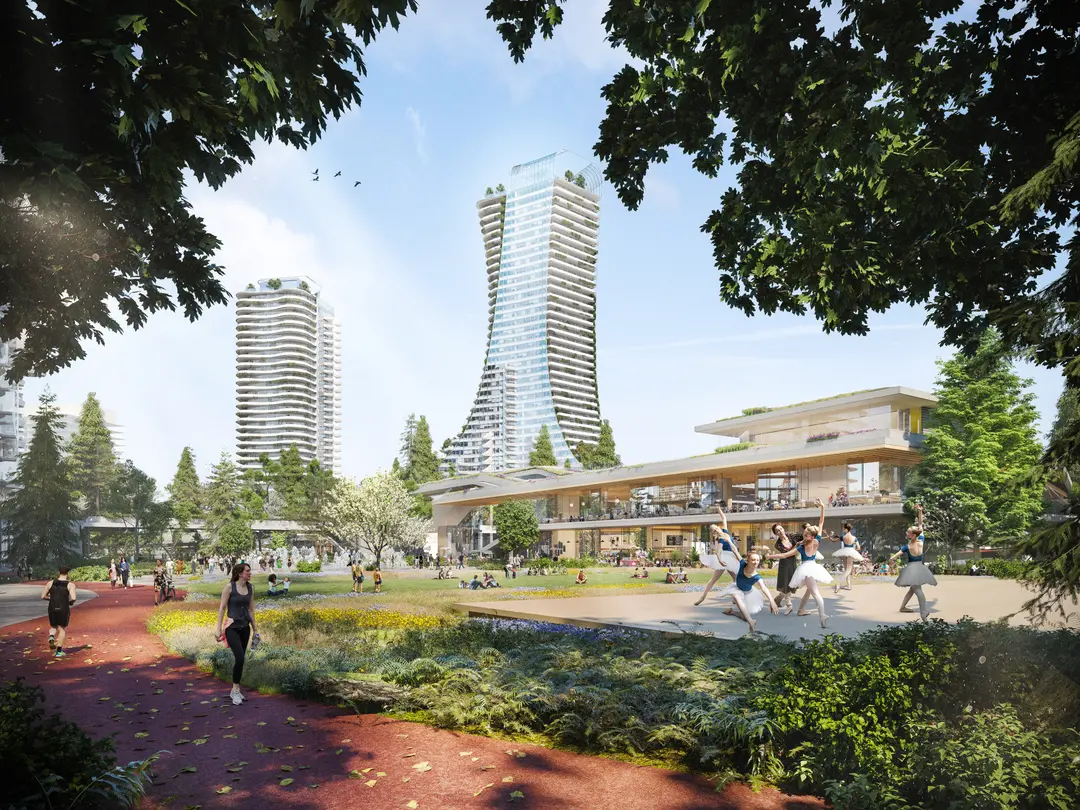
At Oakridge Park, a resident’s front door doesn’t lead directly to a standard sidewalk. Instead, it connects to a multi-tiered, vertical civic hub. The environment integrates public infrastructure with private luxury, rendering the traditional lobby obsolete. Residential elevator banks open seamlessly onto a massive, nine-acre undulating rooftop park. This green space offers distinct woodland trails, community gardens, and performance lawns.
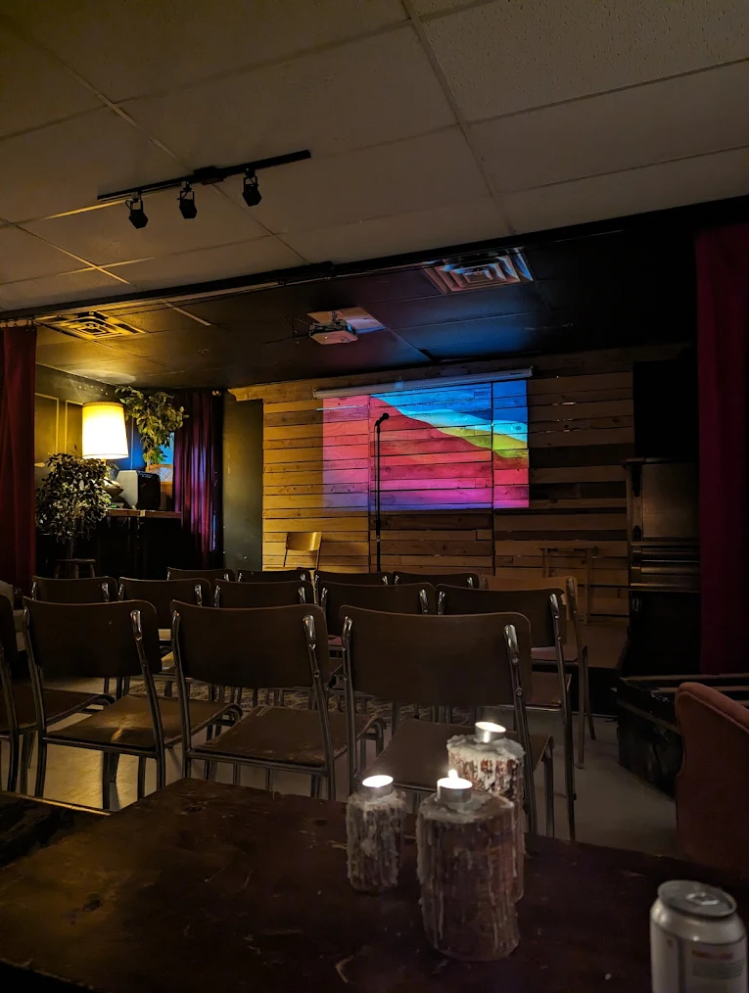
Directly below this green canopy sits a 100,000-square-foot state-of-the-art community center, paired with a brand-new, modern branch of the Vancouver Public Library. A world-class Time Out Market and a dedicated live-music performance venue further activate this civic core. These spaces inject immediate nightlife and cultural relevance directly beneath the residential towers. For an Oakridge resident, the entire development acts as an extension of their home. The project proves that integrated civic space drives an immense premium over private, dead tower square footage.

The Well (Toronto): The Pure Institutional Blueprint
While Mirvish Village and Oakridge Park evolved from visionary boutique origins into institutional triumphs, Toronto’s The Well represents a parallel benchmark. This project was unapologetically institutional from day one. Led by the powerhouse joint venture of RioCan REIT and Allied Properties REIT, The Well spreads 3 million square feet of retail, office, and residential space across nearly eight acres.
Designed by the internationally acclaimed Hariri Pontarini Architects, The Well’s crowning achievement is its jaw-dropping, three-level open-air pedestrian spine. A dramatic, 525-foot fluid glass canopy engineered in Germany shelters this structure. The design completely erases the borders between the private towers above and the public streetscape below.
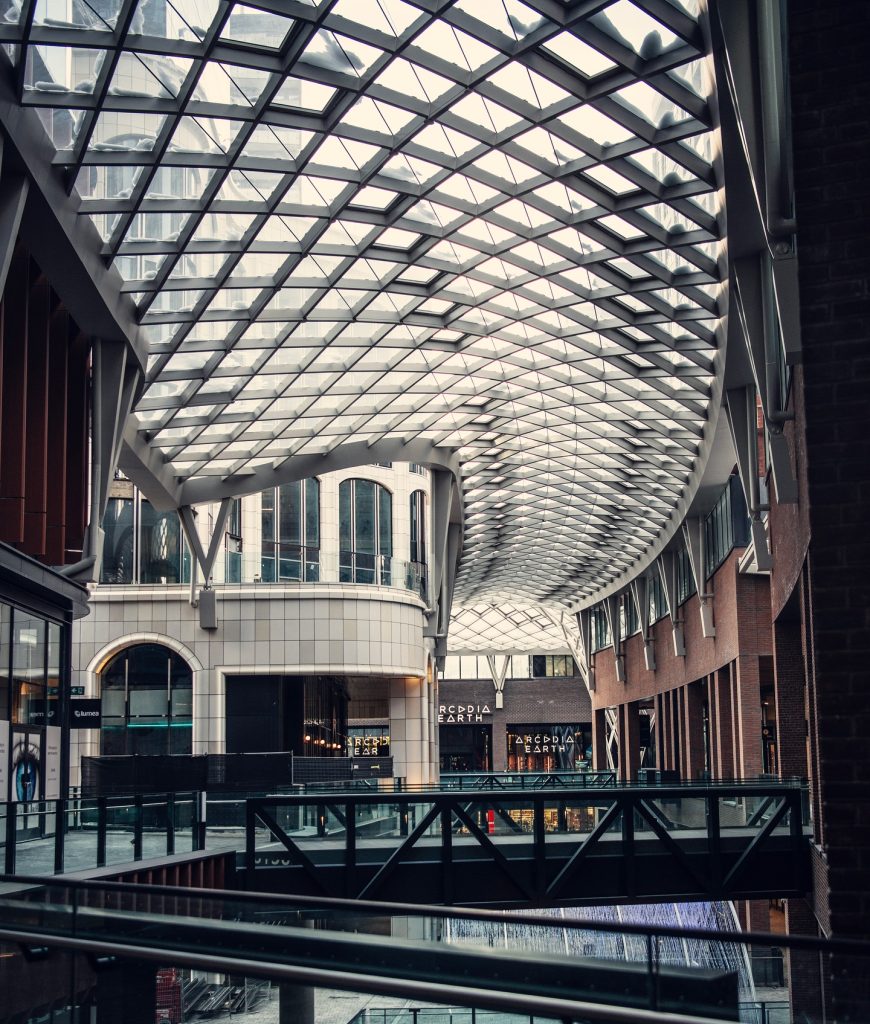
At The Well, the residential lobby functions as a seamless offshoot of a tree-lined, multi-level promenade. On any given day, office workers, neighborhood residents, and tourists flow through this space. The tower bases remain completely porous, activated by a substantial ground-level food hall, wellness spaces, and open plazas. The Well proves that a project can be rigorously institutional, hyper-functional, and intensely placemaking-focused all at once.
Waterworks (Toronto): The Single-Structure Masterclass
It’s easy to look at multi-acre mega-projects like The Well and assume that borderless placemaking can only exist across sprawling urban footprints. But the philosophy behind these grand developments isn’t scale-dependent; it is a mindset. A single, standalone architectural structure can use the exact same civic intelligence. Developers can easily scale down the ethos of master-planned third places into a highly integrated micro-ecosystem.
Waterworks in Toronto’s King West neighborhood provides the ultimate template for this localized approach. Developed through a brilliant adaptive-reuse partnership between MOD Developments and Woodcliffe Landmark Properties, the building features architecture by Diamond Schmitt. Waterworks weaves a 13-story residential boutique condominium directly into a beautifully restored 1932 Art Deco industrial building.
The Micro-Masterplan in Practice
Instead of sequestering its 288 residential units behind a private, dead lobby, Waterworks transforms its entire ground plane into a porous public asset. The footprint connects seamlessly with the northern edge of St. Andrew’s Playground. The residential threshold doesn’t isolate its occupants. Instead, it positions them directly atop a massive, 60,000-square-foot state-of-the-art YMCA and a spectacular, European-style food hall built within the historic building’s soaring Great Hall.

Residents step out of their elevators directly into a thriving culinary destination. The space features artisanal food vendors, craft cocktail bars, and an indoor-outdoor courtyard that functions as the neighborhood’s active living room. By embedding heavy civic infrastructure right at the building’s base, Waterworks breaks down traditional socioeconomic barriers. It proves that a single building can dissolve its perimeter to create an authentic public realm. This strategy turns empty, private lobby square footage into the cultural anchor of an entire community.
The Economics of Master-planned Third Places
For a long time, traditional investment models viewed grand public realms, open-air arcades, and un-anchored community spaces as “soft features.” Analysts saw them as nice elements for marketing brochures, but ultimate drains on net rentable area. That outdated financial modeling has been thoroughly debunked. When blue-chip firms like QuadReal, Peterson, RioCan, and Allied back, execute, and hold these concepts on their balance sheets, they send an unmistakable signal to the wider market. They prove that master-planned third places are the most reliable way to future-proof high-density real estate.
The underlying business logic of the borderless ground plane reveals a stark reality. Sterile, isolated lobbies generate zero return on investment and ultimately build lonely, stagnant towers. Conversely, highly integrated civic spaces cultivate a vibrant sense of place that directly correlates with superior asset performance. Modern urbanites willingly pay a premium to live atop dynamic urban ecosystems. Meanwhile, retail and commercial tenants enjoy consistent, multi-layered foot traffic that protects them from broader economic shifts.
On top of this, developers who offer genuine, world-class civic spaces back to the city tend to win municipal and community support far faster. This alignment significantly accelerates the costly zoning and approval pipelines. Ultimately, the future of urban architecture does not belong to the developments that build the tallest walls. It belongs to those that design the most welcoming thresholds. By burying the boring lobby and embracing the vibrant complexity of the shared public realm, progressive capital creates a resilient new standard for the modern city.