How Trinity Bellwoods Perfected the 15-Minute City Lifestyle
How Trinity Bellwoods Perfected the 15-Minute City Lifestyle
For decades, early urban planners operated with a clear mandate. They wanted to separate our daily activities as much as possible. This layout wasn’t a corporate conspiracy. Instead, it was an overcorrection to the dirty, coal-fired smog of the Industrial Revolution. To protect public health, cities created rigid single-use zoning laws. These laws legally forced residential housing, commercial shops, and industrial workplaces into isolated silos. However, this protective strategy overshot its mark. It built a car-dependent landscape that structurally forced residents into daily traffic jams just to buy a container of milk.
Today, the modern lifestyle aspiration has flipped completely on its head. The ultimate contemporary luxury isn’t a faster highway commute. It’s the total eradication of it. Urbanites increasingly crave a lifestyle model where daily essentials sit within a comfortable, sun-dappled walk from their front door. They want their grocery store, morning espresso, evening wine bar, and social circle nearby.
Urban planners globally debate the theoretical frameworks of this hyper-local design. Much of this discussion relies on research featured on Science Canada. Their data tracks the distinct drop in vehicle reliance when neighborhoods cluster essential amenities together.
Meanwhile, a dense pocket in Toronto’s west end has quieted the skeptics. It shows exactly how trinity bellwoods 15 minute city dynamics function in the real world. The neighborhood’s unique physical framework provides the structural canvas for density. We explored those lot depths and zoning rules in our previous look at How the Bellwoods Blueprint Unlocks Toronto’s Multiplex Frontier. However, the true magic of the area lies entirely in its human choreography. This daily, unscripted social infrastructure transforms a dense urban pocket into a deeply connected, human-scale home.
The Park as the Communal Living Room
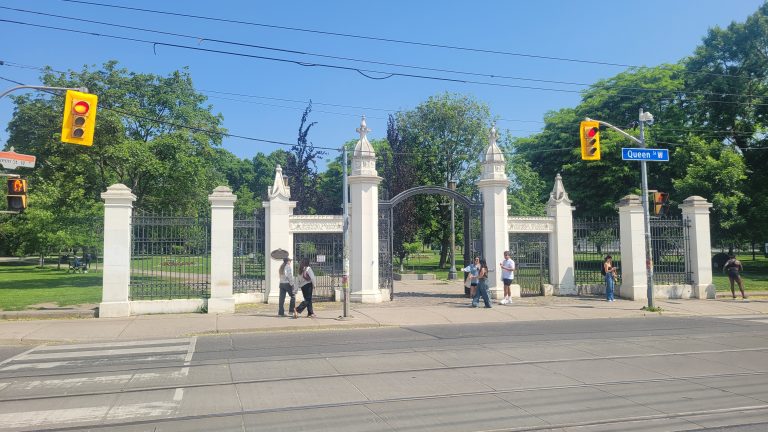
In a traditional agrarian village, the town square served as the inevitable point of convergence. In a vertical, modern metropolis, private backyards are often traded for high-density living spaces. Trinity Bellwoods Park fills that exact ancestral role. It functions quite literally as the neighborhood’s collective living room.
Tightly packed Victorians and nearby mid-rises populate the surrounding residential streets. Because of this density, domestic life naturally spills outward. The park isn’t just a place you visit for a structured workout. You go there because your indoor walls feel a little too close, and you need to see humanity.
This reality creates a distinct social equalizer. On any given weekend, the topography of the park dictates a flawless, organic layout of subcultures. Along the western edge sits the sunken ravine of the Dog Bowl. This area is a glacial remnant of the long-buried Garrison Creek. It naturally gathers hundreds of off-leash dogs and their owners. The ravine acts as a low-stakes networking hub where standard urban barriers drop.
Nearby, blankets overlap seamlessly on the grassy slopes. They turn a casual Saturday afternoon into a collaborative picnic. Here, artists, tech founders, young families, and restaurant industry workers share ice, corkscrews, and conversation. Meanwhile, the tennis courts, baseball diamonds, and volleyball nets provide a steady visual hum of kinetic energy. They frame the green space as an open-source community center.
There’s an unwritten contract of shared space here. A profound sense of psychological ownership takes root when a neighborhood treats 36 acres of grass as a personal backyard.
The Hyper-Local Micro-Economy
A village cannot survive merely on leisure. It requires a self-sustaining economic pulse. Trinity Bellwoods is uniquely cradled by three of the city’s most vibrant commercial strips. Queen Street West sits to the south, while Dundas Street West frames the north. Ossington Avenue firmly anchors the neighborhood’s western edge as it stretches out toward Dovercourt Road. Together, these streets form a commercial ecosystem completely anchored by an independent ethos.
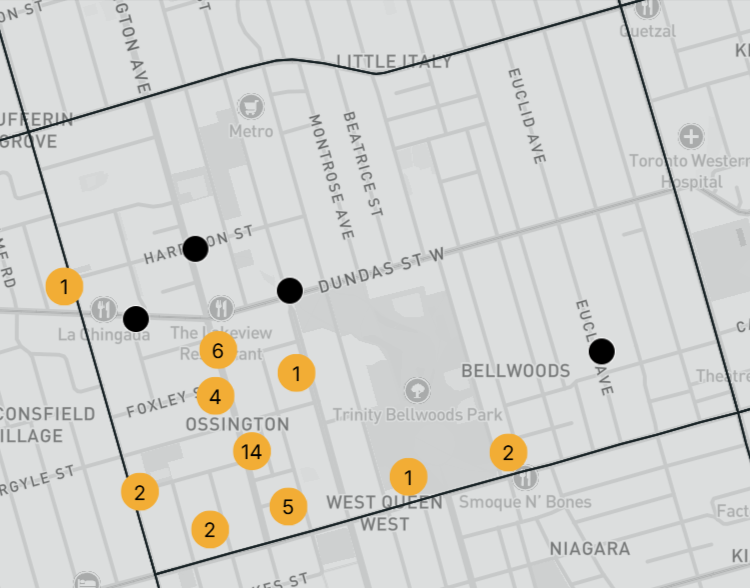
This geographic layout creates an economic resilience built entirely on foot traffic. Big-box retail chains are conspicuously absent. In their place, curated, artisanal businesses function as vital Third Places. These are the social surroundings separate from the two usual environments of home and work.
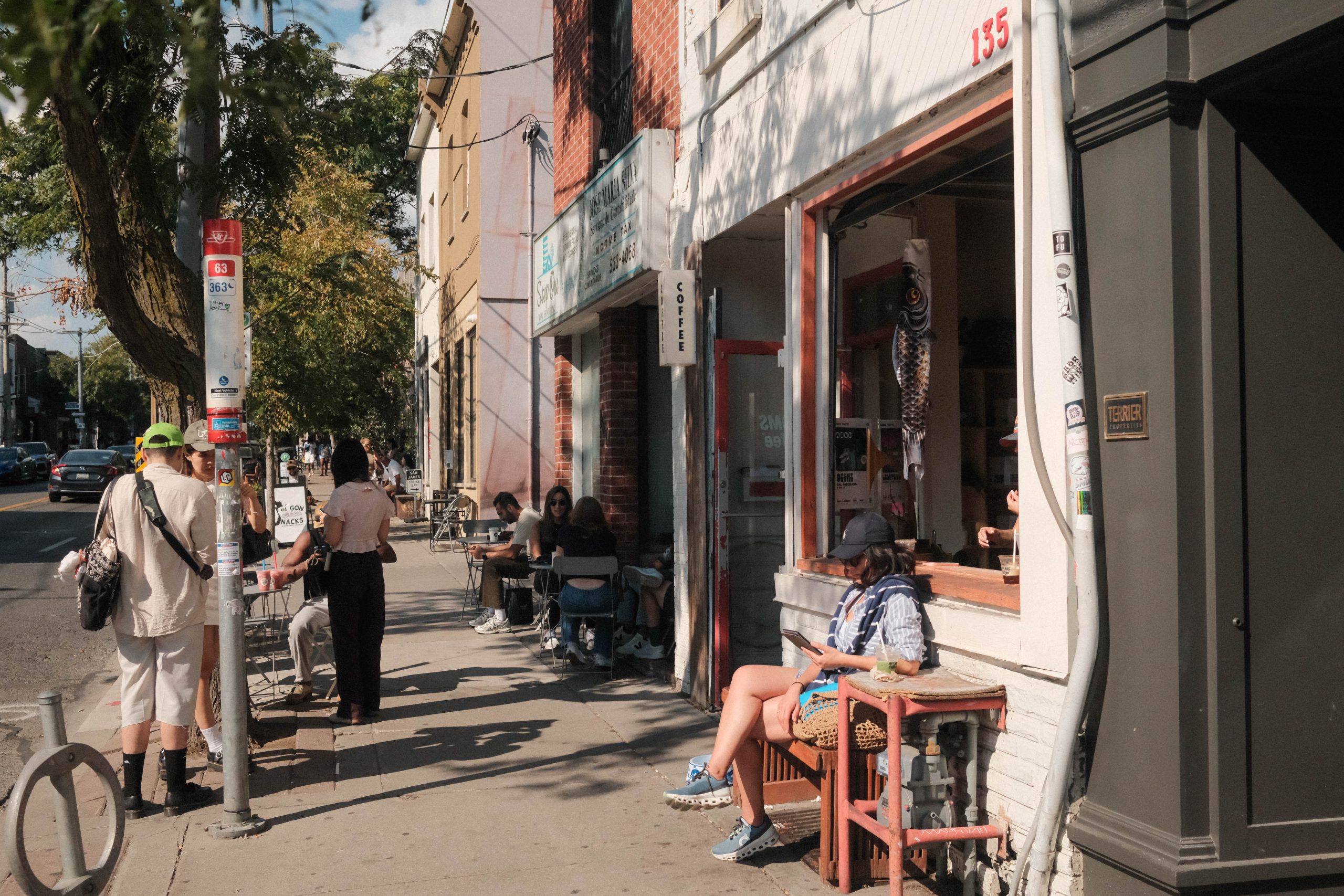
The lifestyle flow here relies on small, frequent transactions. It replaces massive, weekly grocery hauls with daily walks. You walk to the local Portuguese bakery for a morning pastry. You drop by the independent butcher or the specialized organic grocer on Dundas for dinner ingredients. Later, you pick up a bottle of low-intervention wine from an Ossington bottle shop. Because these transactions happen at a human scale, merchants quickly learn your name. They remember your dog’s name and your coffee order. This repetitive, micro-retail intimacy provides the exact antidote to urban alienation.
The Active Flow: Porches, Grids, and Alleys
The physical design of the neighborhood directly dictates its social choreography. Trinity Bellwoods benefits from a classic Victorian grid system. This layout features narrow streets, mature tree canopies, and an extensive network of rear laneways.
The tight layout and restricted parking naturally slow down car traffic. Because of this, active mobility becomes the default setting for residents. People walk, cycle, or skate to get around.
This structural layout fosters a vibrant front-porch culture. Houses sit close to the sidewalk, separated only by tiny front gardens or small steps. When you sit on a Bellwoods porch, you are firmly participating in the public realm. You greet neighbors walking by and track the changing of the seasons. You keep a passive, collective eye on the street.
The neighborhood’s laneways and hidden alleys add another layer to this flow. They serve as quiet, pedestrian-only corridors that bisect the blocks. They allow residents to slip away from the bustling energy of the commercial strips. Instantly, you find yourself in a secluded, residential sanctuary. This seamless transition between high-octane cultural energy and deep domestic quiet makes the lifestyle feel sustainable over the long term.
The Anatomy of a Bellwoods Saturday
9:00 AM: The morning pilgrimage. A slow walk down a tree-lined street to grab a flat white from a favorite local independent café. Neighbors exchange nods on front porches.
1:30 PM: The park convergence. Setting up a canvas blanket near the tennis courts. The conversation isn’t planned, but within an hour, three different friend groups have merged blankets.
7:00 PM: The evening migration. Packing up the cooler and walking five minutes over to an intimate, chef-driven restaurant on Ossington for a late dinner, entirely bypassing the need for a car or rideshare.
The Cultural Cost of the “Lifestyle Brand”
However, no blueprint is without its design flaws. The greatest threat to the Trinity Bellwoods model is, ironically, its own hyper-desirability. Over the last decade, the neighborhood has transitioned significantly. It evolved from an organic community of creatives and working-class families into a premium lifestyle brand.
When a neighborhood becomes a global signifier of cool, market forces react predictably. The soaring cost of entry creates a real risk of cultural displacement. The danger here isn’t just that real estate prices rise. The true risk is that the community’s social fabric turns into a wealthy monoculture.
Quirky vintage shops, low-cost community spaces, and experimental art studios face immense pressure. When they can no longer afford the commercial rents on Queen or Ossington, they disappear. Well-funded, corporate lifestyle brands inevitably replace them, often mimicking the independent aesthetic. If a modern village loses the very eccentricities that built its cultural equity, it risks becoming a sanitized outdoor mall. Maintaining true social vitality requires protecting space for the unpredictable, the uncurated, and the unprofitable.
Beyond Bellwoods: Toronto’s Macroscopic Village Grid
It’s vital to recognize that Trinity Bellwoods isn’t a lonely urban anomaly. It’s part of a broader network of neighborhoods keeping this dream alive. Across Toronto, several districts have mastered this identical human scale:
- Roncesvalles & High Park: Serving as the definitive west-end village anchored by Polish heritage, small grocers, and a massive green escape.
- Little Italy: Balancing a historic main-street patio culture with quiet, deeply shaded residential streets just steps away.
- Summerhill: A refined midtown hub where high-density luxury meets walkable park networks and curated retail.
- Riverdale & Leslieville: Anchoring the east end with a mirrored twin of the Bellwoods lifestyle, complete with independent roasters, brunch spots, and the sweeping skyline views of Riverdale Park East.
What truly sets Toronto apart on a macro level is its continuous, interconnected layout. The city’s pre-automobile streetcar grid means these 15-minute neighborhoods are completely woven together. You can literally walk from the heart of Little Italy and slip seamlessly through Trinity Bellwoods. Then, you find yourself in the bustling core of Queen West without ever breaking your pedestrian flow. The social infrastructure is continuous.
This stands in stark contrast to other major Canadian cities like Vancouver. Vancouver possesses world-class, rapidly growing 15-minute communities. Examples include the beachside charm of Kitsilano or the bohemian independent energy of Little Mountain and Main Street. However, these pockets are often structurally fragmented.
In Vancouver, these vibrant areas are frequently cordoned off by massive, high-speed arterial corridors. Streets like Broadway, 4th Avenue, or Kingsway separate them. Crossing from one neighborhood to another often introduces a sharp dose of pedestrian friction. Walkers must navigate multi-lane car commuter channels. In Toronto, the transition between villages is almost invisible. This layout makes the entire urban core feel like a massive, unbroken patchwork of small towns.
Proximity and Choice: Understanding the 15-Minute City
Trinity Bellwoods shows the practical benefits of hyper-local living. Meanwhile, the underlying planning framework has sparked considerable online discourse. This global concept is known as the 15-minute city. Public conversations occasionally center on concerns regarding municipal zoning boundaries and regulations. However, we should look past the theoretical debates. The actual intent of the model focuses entirely on proximity and expanding daily choices.
The real-world blueprint relies on a simple idea. It states that residents get to access their core needs close to home. Rather than restricting travel, the model treats community amenities as an upgrade in baseline convenience.
When a neighborhood provides essentials within a short radius, it unlocks distinct advantages. A local grocer, pharmacy, green space, and workplace create three major benefits:
- True Mobility Freedom: Residents can choose to bypass the costs and stress of car ownership for daily errands. Meanwhile, larger regional travel remains completely open-ended.
- Economic Micro-Climates: Keeping retail dollars within a walkable perimeter allows independent merchants to build sustainable, long-term businesses.
- Environmental and Physical Health: Replacing brief, carbon-heavy vehicle trips with walking and cycling naturally cleans local air. It also incorporates passive movement into the daily routine.
The setup of Trinity Bellwoods sets a prime example that true urban freedom means having real alternatives to traffic gridlock. By placing essentials within a short walk, cities don’t restrict where you can travel, but ensure that you don’t have to leave your community simply to live your life.
Ultimately, the Bellwoods blueprint proves the true value of a neighborhood is measured by the strength of its social infrastructure, and reminds us that cities can thrive when we design them around the human foot rather than the automobile axle.When we design communities to favor human proximity, we build a better future.